
Legal Updates
The "W" That Won
By: Eilyn E. Medina-Garcia and Gabriel B. Esguerra
Uploaded: July 13, 2026
Following the landmark case of Kolin Electronics Co., Inc. v. Kolin Philippines International, Inc. (G.R. No. 228165, February 9, 2021) in which the Dominancy Test was definitively adopted in determining the existence of confusing similarity between marks, the Supreme Court recently ruled in Starwood Hotels & Resorts Worldwide, LLC v. Oceanic Empire Limited (G.R. Nos. 262551, 266971, 275314, 28 January 2026) that the registered stylized “W” mark of Starwood Hotels & Resorts Worldwide, LLC (“Starwood”) can prevent the registration of confusingly similar marks, even when the latter marks add words alongside them.
Starwood owns the following marks:
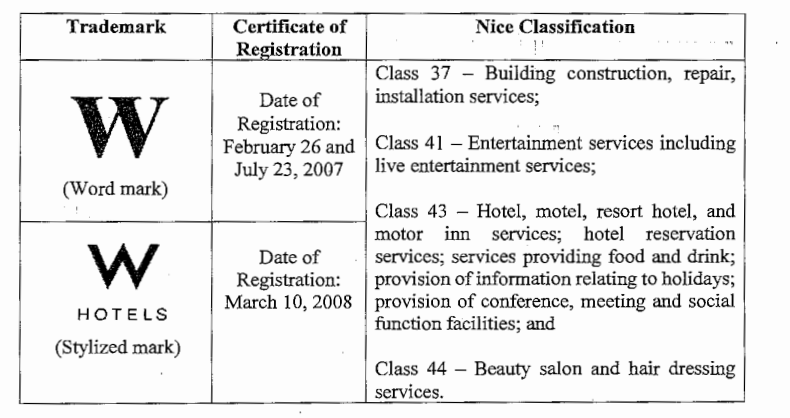
In 2015, Oceanic Empire Limited (“Oceanic”) applied for the registration of the following:
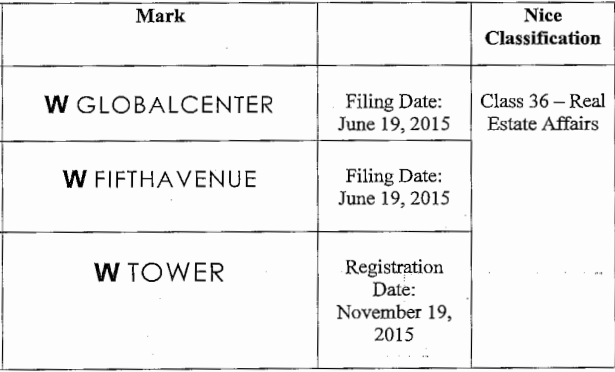
Starwood opposed the registration of W GLOBALCENTER and W FIFTHAVENUE, and asked for the cancellation of the registration of W TOWER.
The Court’s Decision
“W” as the Word Mark
The Court ruled that there is no confusing similarity between Starwood’s “W” mark, as a wordmark, and Oceanic’s marks.
Citing its ruling in Kolin that for word marks “…the word itself is the subject of protection,” the Court declared: “Starwood’s W mark must simply be examined based on it being a standalone letter and removed from whatever differentiation in style and format it may possess. To this extent, We echo the finding of the tribunals below that this cannot be the basis for Starwood to claim distinction in business, such that it can consequently claim exclusivity in the use of a plain letter of the alphabet.” Noting the lower tribunals’ finding regarding the existence of several other trademark registrations which similarly adopted the letter “W”, either as standalone or composite marks and in various styles and representations from other registrants under different classes of goods and services, the Court ruled that “Starwood’s registered “W” mark, as a wordmark, is not sufficiently distinctive to identify Starwood as its single source or origin of business.”
“W” as the Stylized Mark
The Court nevertheless found that Starwood’s Petition was impressed with merit on the basis of the prior registration of Starwood’s W HOTELS (stylized mark), and then denied Oceanic’s two pending applications and cancelled its existing registration.
Applying the Dominancy Test, the Court applied a straightforward principle: when assessing whether two marks are confusingly similar, what matters most is the element that first catches the eye of the ordinary consumer. Here, that element was the stylized “W”.
Both parties used the same bold, clean, uppercase sans-serif design, save for the difference that Starwood placed “Hotel” below the letter “W” while Oceanic placed the words “TOWER”, “FIFTH AVENUE”, and “GLOBALCENTER” parallel or right beside the letter “W“.
According to the Court, the additional words Oceanic placed alongside “W” did not meaningfully change the overall visual impression. Those additional words were found to be generic or merely descriptive. “Tower” and “Hotels” name the type of building. “Fifth Avenue” and “Global Center” describe a location or commercial purpose. No one has exclusive rights to such terms, and the Court noted that Oceanic itself had formally relinquished its exclusive claim to “Global Center” during the registration process, which undermined its argument that those words distinguished the mark.
The Court also considered how both parties displayed their marks in practice. Both companies prominently featured the stylized “W” on their building facades, and Oceanic’s marks were at times shown using only the “W” or with the additional words placed below the letter, mirroring Starwood’s own layout.
On the relatedness of the parties’ services, the Court found that despite operating in different sectors, both businesses involve high-end real property, target the luxury market, and build their brand identities around premium buildings. Consumer confusion between the two was held to be plausible. The Court also held that Starwood’s online presence – through which Filipino consumers can access and book its hotels – was sufficient to establish its commercial footprint in the Philippines, even without a local hotel.
This article is only for informational and educational purposes, and it is not intended as a legal advice or opinion. For assistance and legal queries, please contact general@srmo-law.com.